

MCI® Technology Used to Restore Historical Buildings in Europe:
Shielding the Past: Sustainable Solutions Restore Historic Monuments in Zadar and Ilok
June 10, 2026
Saint Donatus, the symbol of the city of Zadar, Croatia, is classified among the most famous and valuable monuments in Europe. Due to its unique cylindrical appearance and robust monumentality, it is one of the most significant European pre-Romanesque churches. As a protected cultural heritage site, it is listed in the Register of Cultural Goods of the Republic of Croatia and is under UNESCO protection. However, as a result of numerous factors, this valuable monument required urgent rehabilitation.
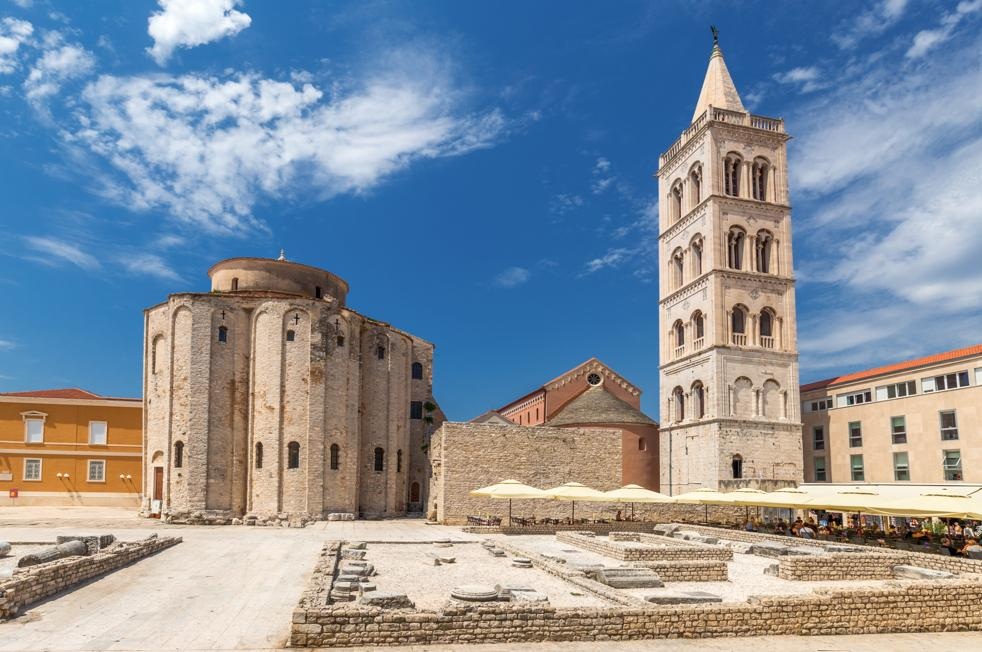
3D scanning analysis determined that the most critical issues were the church walls, the main structure, and the roof. Historically, between 1927 and 1930, the stability of the foundation was compromised, leading to the implementation of a reinforced concrete support structure under the roof on the south side, which connects the church's outer and inner rings.
The reinforced concrete structure supporting the Church of St. Donatus was seriously threatened by moisture penetration and corrosive sea spray affecting the medieval monument. A repair project was initiated and Cortec’s MCI®-2020 inhibitor was specified as coating to protect support structure against corrosion. MCI®-2020 is a surface applied corrosion inhibitor designed to migrate through even the densest concrete structures and seek out the steel reinforcement bars in concrete. Even when not in direct contact with metal, the product will migrate through concrete to provide full protection. This environmentally safe inhibitor stops further corrosion of reinforcing metals, significantly extending the service life of the structure.
Renovation of Medieval City Walls of Town of Ilok
The town of Ilok, Croatia, is a place steeped in rich history and cultural heritage. Its medieval fortress walls and royal castle are protected historical treasures, allowing visitors to truly step back in time. The tower walls have a square floor plan and rest on foundations made of broken stone. These walls are exposed to damaging atmospheric influences; over time, the mortar between the bricks has washed away, leading to the deterioration of the masonry. Restoration work on 'Tower Three' included strengthening the foundations, rebuilding collapsed sections, and injecting cracks to restore structural integrity. The project involved the use of corrosion inhibitors to prolong the life of the structure. MCI®-2005 was added to a new concrete foundation being used to support the old foundation. Special attention was given to protecting reinforcing metals in the concrete because of the new foundation’s contact with the soil. Rather than using stainless steel reinforcement, the project opted for black steel reinforcement plus MCI®-2005. MCI®-2018 was applied to brick walls.
As a Migrating Corrosion Inhibitor™ admixture, MCI®-2005 protects embedded metal reinforcement in the new concrete supporting the foundations. MCI®-2018 functions as a water repellent to help protect bricks and mortar from the effects of outdoor weather. Both products were simple additions to significantly improve the longevity of the restoration project without changing the structure’s appearance. MCI®-2005 is a USDA Certified Biobased Product.
By integrating advanced MCI® technology into these historic restorations, Cortec® ensures that Europe’s cultural treasures are not only repaired for today, but sustainably preserved for generations to come.
You can learn more about Migrating Corrosion Inhibitors (MCI®) here: https://www.cortecmci.com/
Need a High-Resolution Photo? Please Visit: www.cortecadvertising.com
For a PDF version please click here.
Related Articles
- FEATURED IN: Protecting the Past: Sustainable Solutions Restore Historic Monuments in Croatia Featured in Refurb Renovation News
- FEATURED IN: Cortec's MCI® Technology Used to Restore Historical Buildings in Europe Featured in CT Today Magazine
- FEATURED IN: Cortec's MCI® Technology Used to Restore Historical Buildings in Europe Featured in PCT Magazine
- FEATURED IN: Cortec MCI Technology Restores Croatia Monuments Featured in CW Magazine